The Adult Congenital Heart Program at Stanford specializes in treating adults who were born with congenital heart defects. Although most patients will have undergone corrective surgery, some may not have been previously treated, or may have recently discovered complex residual conditions requiring therapy involving drugs, interventional procedures, or surgery.
The Adult Congenital Heart Program at Stanford offers:
• Leading cardiothoracic surgeons who are experts in repairing congenital heart lesions across all age groups.
• A highly specialized program specifically designed for adolescent and adult patients with congenital heart defects.
• Advanced treatment options for pulmonary valve repair in patients with tetralogy of Fallot, transcatheter ASD closure, and pulmonary valve replacement, as well as
alternative therapies such as ventricular assist devices and heart/lung transplantation.

List of MD’s

Anitra Romfh, Clinical Associate Professor of Cardiology

Christiane Haeffele, Cardiologist, Clinical Associate Professor
Mohan Viswanathan, Cardiac Electrophysiologist, Clinical Professor

Kara Motonaga, Cardiac Electrophysiologist, Clinical Professor
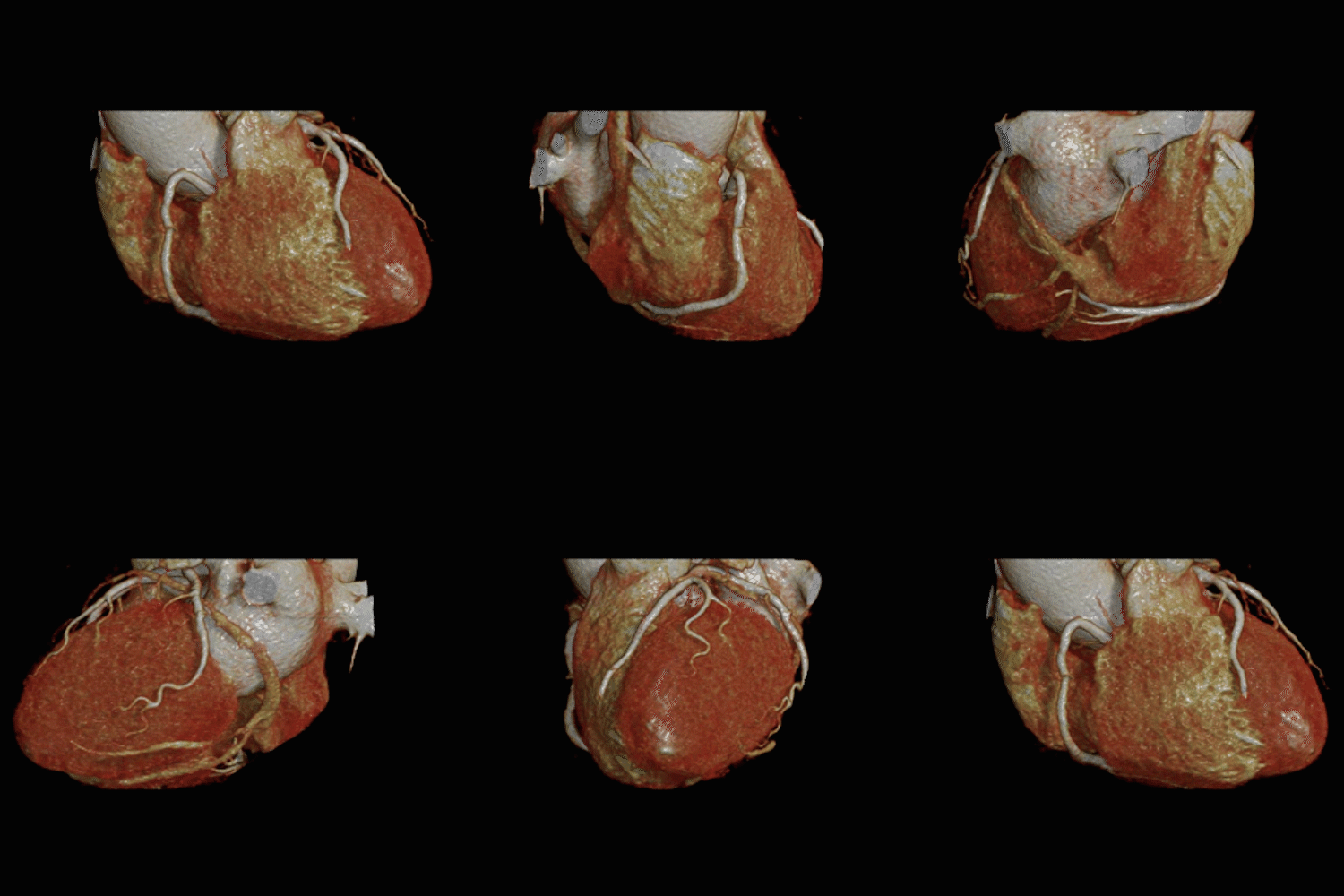
Our Heart & Coronary Angiography service utilizes CT coronary angiography to assess the heart for hemodynamically significant calcific and soft plaques, as well as any anomalous anatomy, which may be useful for diagnosing and managing cardiovascular disease. We perform Curved Planar Reformation (CPR) on areas with minimal motion artifact, ensuring the clearest possible visualization of each coronary artery.
The service includes creating detailed CPRs for the Left Anterior Descending (LAD), Left Circumflex (LCX), Right Coronary Artery (RCA), and any bypass grafts, annotating native vessel names for understanding. We further enhance our evaluations with a 360-degree loop of each CPR providing an all-encompassing view of coronary anatomy.
For optimal clarity, our segmentation process selects the cardiac phase with the least motion, focusing solely on the heart to include muscle tissue, coronary arteries, and the proximal aorta. We remove extraneous structures only as necessary, preserving the integrity of the heart model.
Our service also offers a variety of captures, including lateral and AP views of the RCA, oblique views for LAD and LCX visualization, and superior views to demonstrate vessel origins, among others. These targeted views and visual reconstructed images allow for the detailed demonstration of vessels or pathology, assisting treatment strategies and improving patient outcomes in cardiovascular care.


Our Heart Mass and Flow service is dedicated to utilizing advanced scanning techniques for an in-depth assessment of cardiac morphology, function, and flow. This comprehensive approach allows for the detailed evaluation of various cardiac conditions, including congenital malformations, aortic valve issues, restrictive cardiomyopathy, and cardiac tumors. By analyzing the structure of the heart, we can identify anatomical abnormalities that may impact its function.
In addition to morphological assessments, our service focuses on evaluating cardiac function, including measurements of ejection fractions and mass analysis. These functional analyses provide insights into the heart's performance, aiding in the detection and management of conditions affecting cardiac efficiency.
Furthermore, our service meticulously examines flow through the cardiac valves, enabling the identification of flow abnormalities that could indicate valvular diseases or other cardiac issues. By integrating assessments of morphology, function, and flow, our Heart Mass and Flow service offers a holistic view of cardiac health, supporting healthcare professionals in diagnosing and treating heart conditions with greater precision. This integrated approach ensures that patients receive targeted interventions based on comprehensive and accurate cardiac evaluations.


Our 3D Printing Service provides anatomical 3D printed models for surgical planning and education. 3D prints can be requested during the 3D imaging ordering process. To achieve optimal results we require high-resolution CT or MRI scans. Once the scan is obtained, we begin the process by segmenting the medical images to isolate specific anatomical structures. This segmented data is then converted into a 3D model and reviewed by the requestor.
Final models are produced using advanced 3D printing technologies such as Fused Deposition Modeling (FDM), Stereolithography (SLA), and PolyJet. We offer hand delivery for on-site requestors and mail delivery for those at other Stanford locations. Additionally, we are exploring the development of custom cutting guides to assist in surgical procedures.


